The recommended method for running Sunshine is to use the binaries included in the latest release, unless otherwise specified.
Pre-releases are also available. These should be considered beta, and release artifacts may be missing when merging changes on a faster cadence.
Binaries
Binaries of Sunshine are created for each release. They are available for FreeBSD, Linux, macOS, and Windows. Binaries can be found in the latest release.
- Note
- Some third party packages also exist. See Third Party Packages for more information. No support will be provided for third party packages!
Install
Docker
- Warning
- The Docker images are not recommended for most users.
Docker images are available on Dockerhub.io and ghcr.io.
See Docker for more information.
FreeBSD
Install
- Download the appropriate package for your architecture
- Open terminal and run the following command.
sudo pkg install ./Sunshine-FreeBSD-14.3-{arch}.pkg
Uninstall
Linux
CUDA Compatibility
CUDA is used for NVFBC capture.
- Note
- See CUDA GPUS to cross-reference Compute Capability to your GPU. The table below applies to packages provided by LizardByte. If you use an official LizardByte package, then you do not need to install CUDA.
CUDA Compatibility
| CUDA Version | Min Driver | CUDA Compute Capabilities | Package |
| 12.9.1 | 575.57.08 | 50;52;60;61;62;70;72;75;80;86;87;89;90;100;101;103;120;121 | sunshine.AppImage |
| sunshine-ubuntu-22.04-{arch}.deb |
| sunshine-ubuntu-24.04-{arch}.deb |
| sunshine-debian-trixie-{arch}.deb |
| sunshine_{arch}.flatpak |
| Sunshine (copr - Fedora) |
| Sunshine (copr - OpenSUSE) |
| sunshine.pkg.tar.zst |
AppImage
- Attention
- Use distro-specific packages instead of the AppImage if they are available. AppImage does not support KMS capture.
- Note
- The AppImage is built on Ubuntu 22.04, which requires
glibc 2.35 or newer and libstdc++ 3.4.11 or newer.
Install
- Download sunshine.AppImage into your home directory.
cd ~
wget https://github.com/LizardByte/Sunshine/releases/latest/download/sunshine.AppImage
- Open terminal and run the following command.
./sunshine.AppImage --install
Run
./sunshine.AppImage --install && ./sunshine.AppImage
Uninstall
./sunshine.AppImage --remove
ArchLinux
- Attention
- Use AUR packages at your own risk.
Install Prebuilt Packages
Follow the instructions at LizardByte's pacman-repo to add the repository. Then run the following command.
Install PKGBUILD Archive
Open terminal and run the following command.
wget https://github.com/LizardByte/Sunshine/releases/latest/download/sunshine.pkg.tar.gz
tar -xvf sunshine.pkg.tar.gz
cd sunshine
# install optional dependencies
pacman -S cuda # Nvidia GPU encoding support
pacman -S libva-mesa-driver # AMD GPU encoding support
makepkg -si
Uninstall
Debian/Ubuntu
Install
Download sunshine-{distro}-{distro-version}-{arch}.deb and run the following command.
sudo dpkg -i ./sunshine-{distro}-{distro-version}-{arch}.deb
- Note
- The
{distro-version} is the version of the distro we built the package on. The {arch} is the architecture of your operating system.
Uninstall
Fedora/OpenSUSE
Install (GitHub releases)
Download Sunshine-{version}.{distro+version}.{arch}.rpm and run the following command.
sudo dnf install ./Sunshine-{version}.{distro}.{arch}.rpm
- Note
- The
{distro+version} is the distro and distro version of the distro we built the package on. The {arch} is the architecture of your operating system.
Uninstall
Install (Copr)
- Important
- Stable builds are only available if the Sunshine release was made after the Fedora version release. Because of this, it is often recommended to use the beta copr; however, you do not need to regularly update. This could lead to annoyances in rare cases where there may be a breaking change.
Enable copr repository.
sudo dnf copr enable lizardbyte/stable
or
sudo dnf copr enable lizardbyte/beta
- Install the package.
sudo dnf install Sunshine
Uninstall
Flatpak
- Attention
- Use distro-specific packages instead of the Flatpak if they are available. Flatpak does not support KMS capture.
Using this package requires that you have Flatpak installed.
Download (local option)
- Download
sunshine_{arch}.flatpak and run the following command.
- Note
- Replace
{arch} with your system architecture.
Install (system level)
Flathub
flatpak install --system flathub dev.lizardbyte.app.Sunshine
Local
flatpak install --system ./sunshine_{arch}.flatpak
Install (user level)
Flathub
flatpak install --user flathub dev.lizardbyte.app.Sunshine
Local
flatpak install --user ./sunshine_{arch}.flatpak
Additional installation (required)
flatpak run --command=additional-install.sh dev.lizardbyte.app.Sunshine
Run with NVFBC capture (X11 Only) or XDG Portal (Wayland Only)
flatpak run dev.lizardbyte.app.Sunshine
Uninstall
flatpak run --command=remove-additional-install.sh dev.lizardbyte.app.Sunshine
flatpak uninstall --delete-data dev.lizardbyte.app.Sunshine
Homebrew
- Important
- The Homebrew package is experimental on Linux.
This package requires that you have Homebrew installed.
Install
brew update
brew upgrade
brew tap LizardByte/homebrew
brew install sunshine
Uninstall
macOS
- Important
- Sunshine on macOS is experimental. Gamepads do not work.
DMG
Install
- Download and install based on your architecture:
- Open the downloaded
.dmg file.
- Drag
Sunshine.app into the Applications folder.
- Eject the disk image.
Uninstall
- Quit Sunshine if it is running.
- Open
Finder, navigate to Applications, and drag Sunshine.app to the Trash.
Homebrew
This package requires that you have Homebrew installed.
Install
brew update
brew upgrade
brew tap LizardByte/homebrew
brew install sunshine
Uninstall
Windows
- Note
- Sunshine supports ARM64 on Windows; however, this should be considered experimental. This version does not properly support GPU scheduling and any hardware acceleration.
Installer (recommended)
- Attention
- The msi installer is preferred moving forward. Before using a different type of installer, you should manually uninstall the previous installation.
- Download and install based on your architecture:
- Attention
- You should carefully select or unselect the options you want to install. Do not blindly install or enable features.
To uninstall, find Sunshine in the list here and select "Uninstall" from the overflow menu. Different versions of Windows may provide slightly different steps for uninstall.
Standalone (lite version)
- Warning
- By using this package instead of the installer, performance will be reduced. This package is not recommended for most users. No support will be provided!
- Download and extract based on your architecture:
- Open command prompt as administrator
Firewall rules
Install:
cd /d {path to extracted directory}
scripts/add-firewall-rule.bat
Uninstall:
cd /d {path to extracted directory}
scripts/delete-firewall-rule.bat
Windows service
Install:
cd /d {path to extracted directory}
scripts/install-service.bat
scripts/autostart-service.bat
Uninstall:
cd /d {path to extracted directory}
scripts/uninstall-service.bat
Initial Setup
After installation, some initial setup is required.
FreeBSD
Virtual Input Devices
- Important
- To use virtual input devices (keyboard, mouse, gamepads), you must add your user to the
input group.
The installation process creates the input group and configures permissions for /dev/uinput. To allow your user to create virtual input devices, run:
pw groupmod input -m $USER
After adding yourself to the group, log out and log back in for the changes to take effect.
Linux
Services
Start once
systemctl --user start app-dev.lizardbyte.app.Sunshine
Start on boot
systemctl --user --now enable app-dev.lizardbyte.app.Sunshine
- Note
- The service has been renamed to "app-dev.lizardbyte.app.Sunshine" in order to increase compatibility with XDG Desktop Portal, but it is also aliased to "sunshine.service" for convenience.
macOS
The first time you start Sunshine, you will be asked to grant access to screen recording and your microphone.
Sunshine can only access microphones on macOS due to system limitations. To stream system audio use Soundflower or BlackHole.
- Note
- Command Keys are not forwarded by Moonlight. Right Option-Key is mapped to CMD-Key.
- Attention
- Gamepads are not currently supported.
Windows
In order for virtual gamepads to work, you must install ViGEmBus. You can do this from the troubleshooting tab in the web UI, as long as you are running Sunshine as a service or as an administrator. After installation, it is recommended to restart your computer.
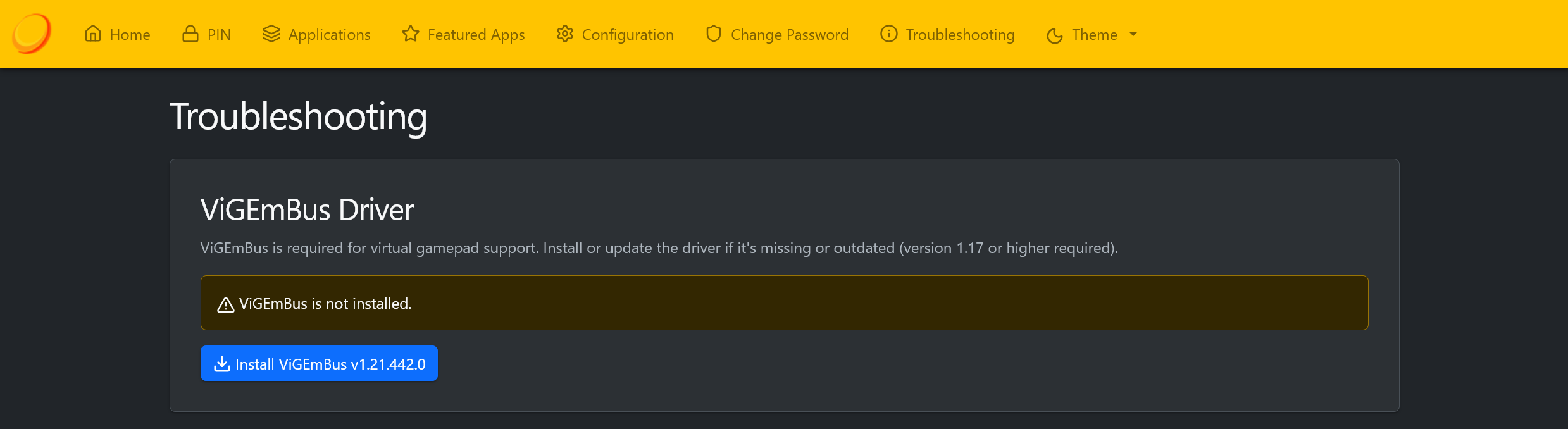
ViGEmBus Installation
Usage
Basic usage
If Sunshine is not installed/running as a service, then start Sunshine with the following command, unless a start command is listed in the specified package install instructions above.
- Note
- A service is a process that runs in the background. This is the default when installing Sunshine from the Windows installer. Running multiple instances of Sunshine is not advised.
Specify config file
sunshine <directory of conf file>/sunshine.conf
- Note
- This step is optional, you do not need to specify a config file. If no config file is entered, the default location will be used. The configuration file specified will be created if it doesn't exist.
Start Sunshine over SSH (Linux/X11)
Assuming you are already logged into the host, you can use this command
ssh <user>@<ip_address> 'export DISPLAY=:0; sunshine'
If you are logged into the host with only a tty (teletypewriter), you can use startx to start the X server prior to executing Sunshine. You nay need to add sleep between startx and sunshine to allow more time for the display to be ready.
ssh <user>@<ip_address> 'startx &; export DISPLAY=:0; sunshine'
Configuration
Sunshine is configured via the web ui, which is available on https://localhost:47990 by default. You may replace localhost with your internal ip address.
- Note
- Ignore any warning given by your browser about "insecure website". This is due to the SSL certificate being self-signed.
- Attention
- If running for the first time, make sure to note the username and password that you created.
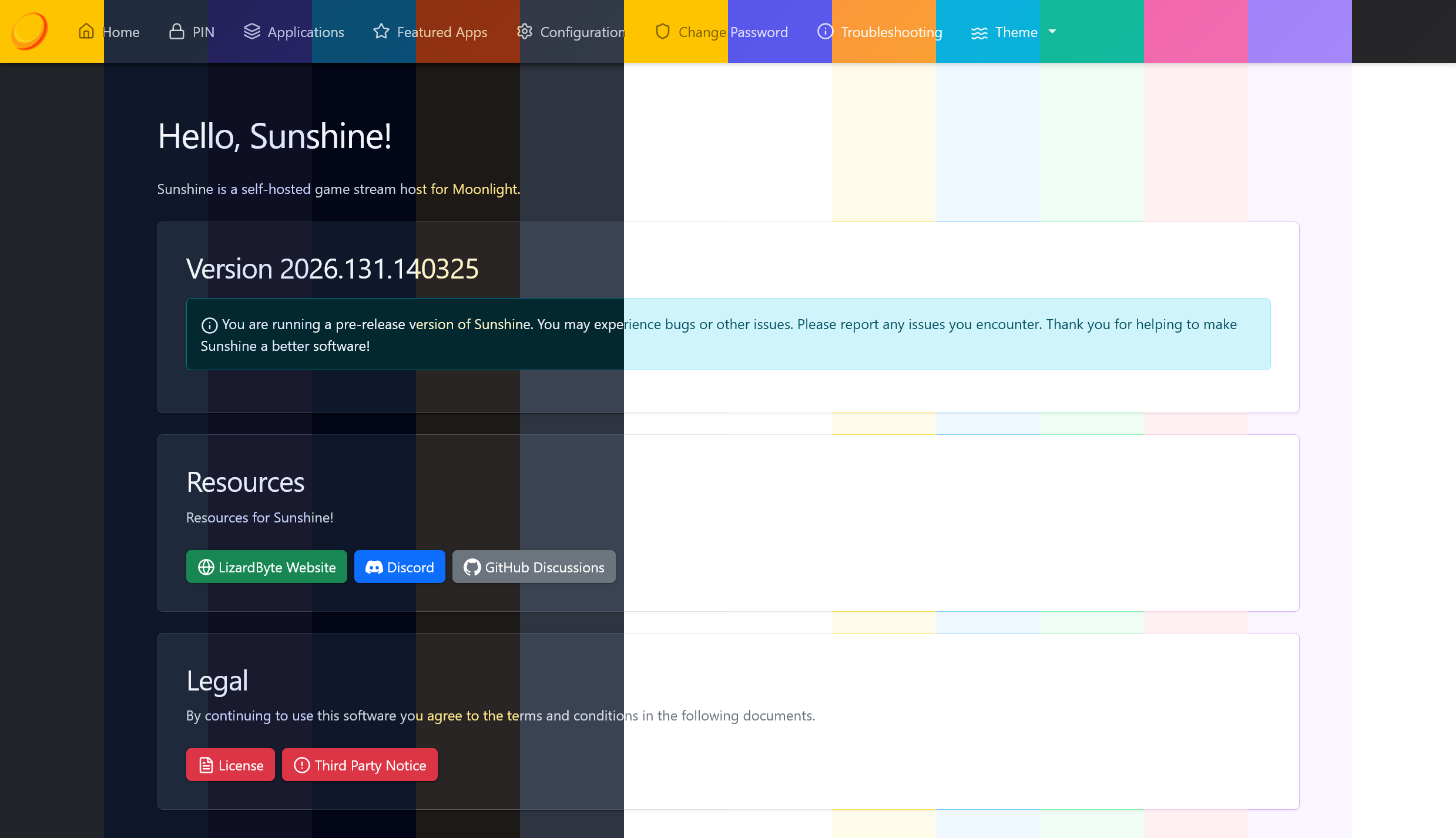
- Change the web-ui to your desired theme, using the dropdown menu in the navbar.
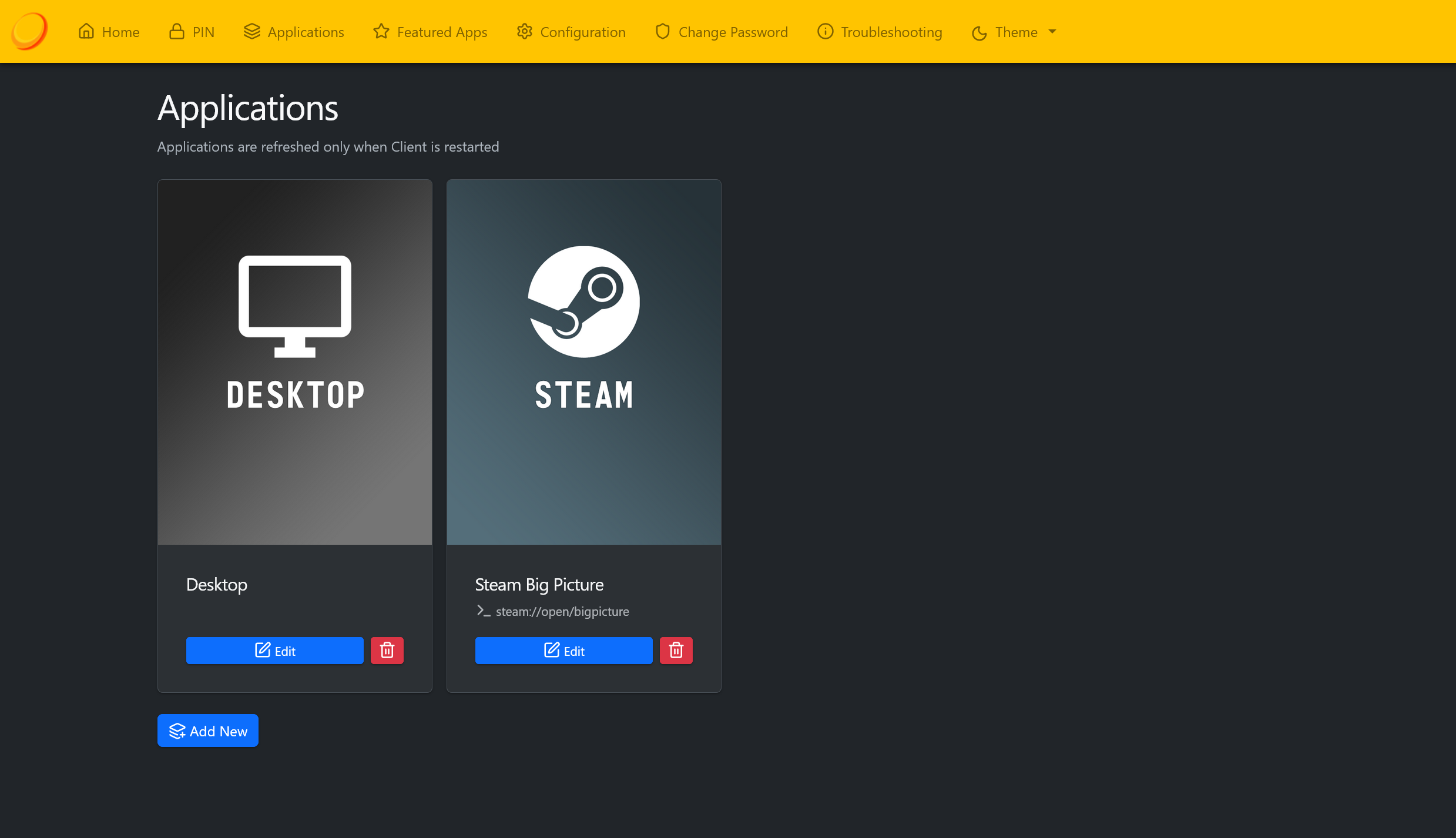
- Add games and applications.
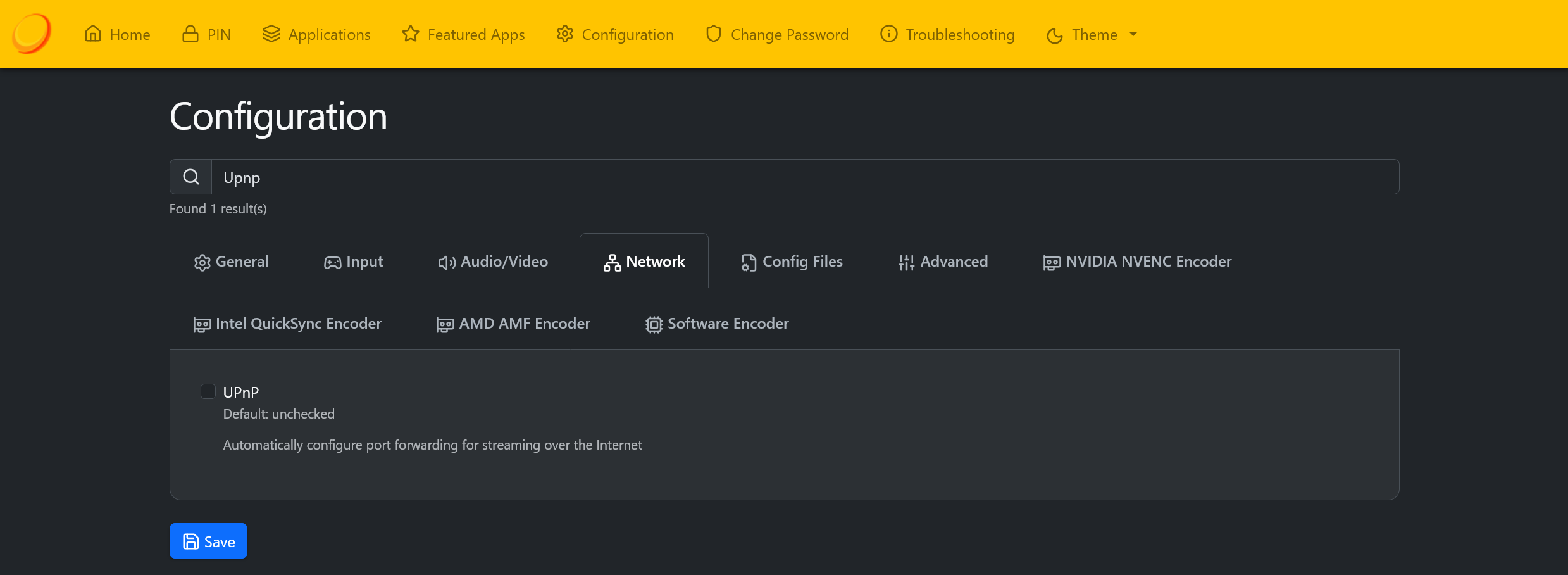
- Adjust any configuration settings as needed. You can search for options in the search bar.
- Find Moonlight clients and other tools for Sunshine in the
Featured Apps tab. 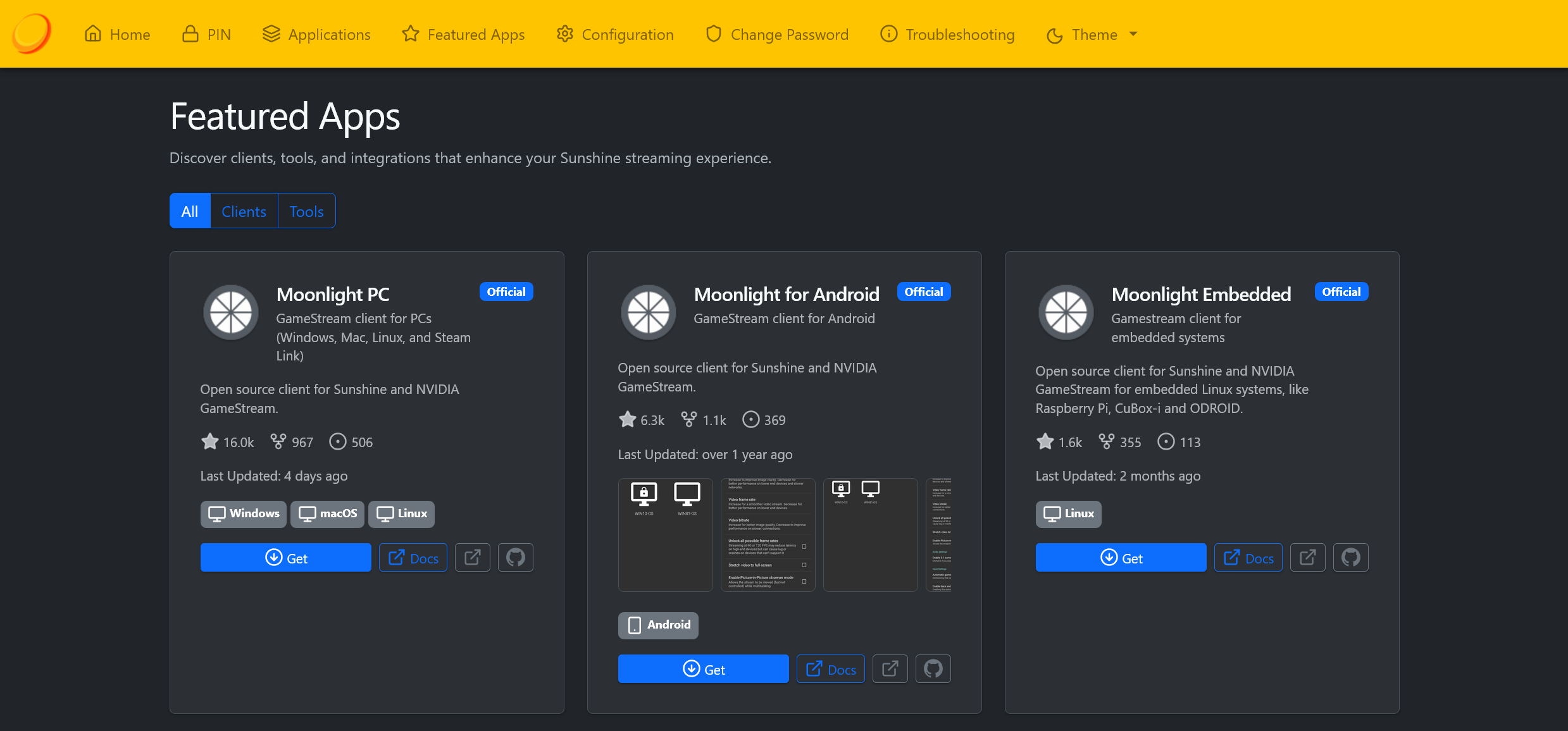
- In Moonlight, you may need to add the PC manually.
- When Moonlight requests for you insert the pin:
- Login to the web-ui
- Go to "PIN" in the Navbar
- Type in your PIN and press
Enter, and enter a name of your choosing for the device. You should get a Success Message!
- In Moonlight, select one of the Applications listed
- If you run into issues, logs are available in the
Troubleshooting tab. You can navigate through each warning/error message for clues to the issue. 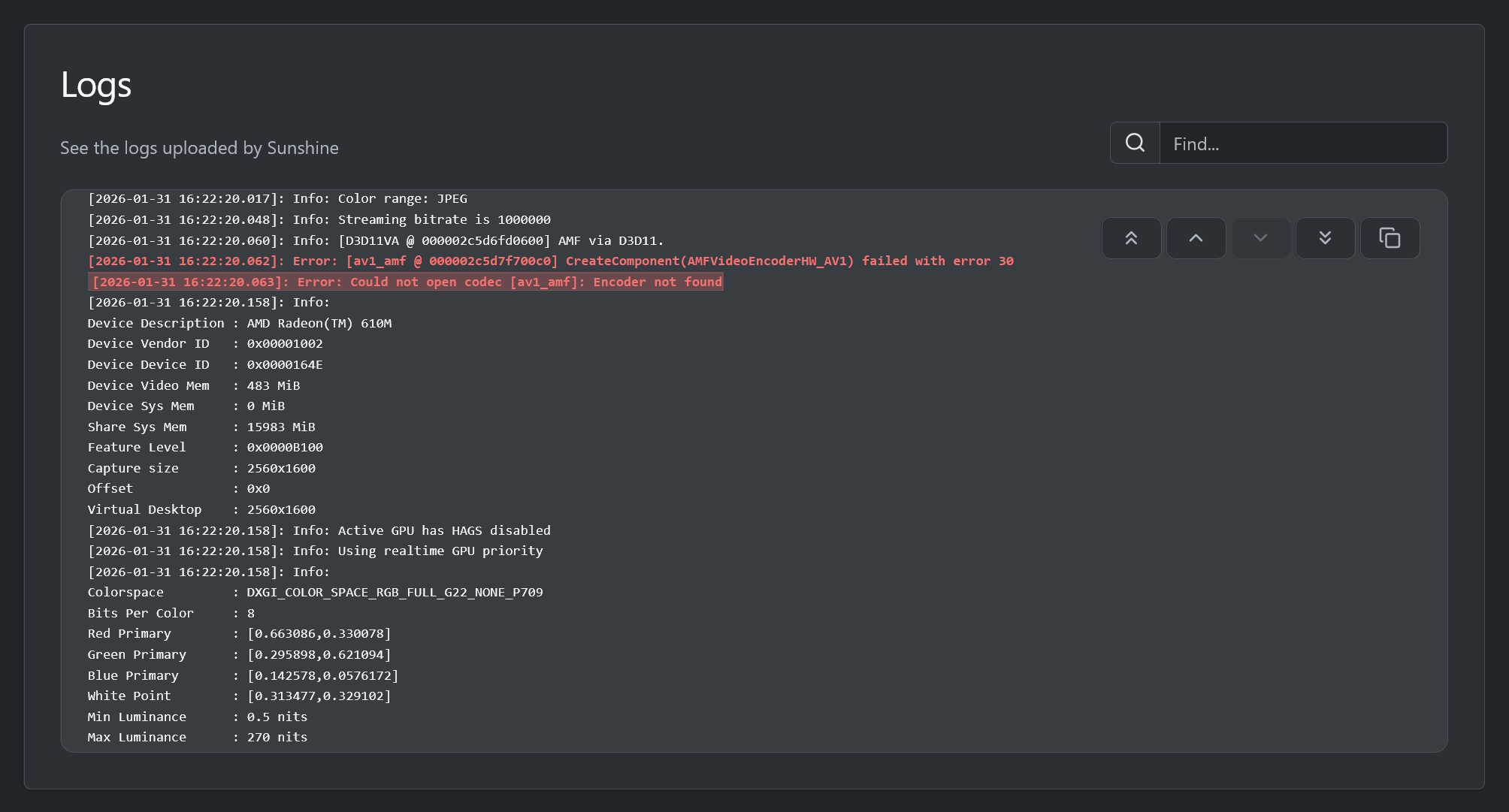
Arguments
To get a list of available arguments, run the following command.
- General
- AppImage
./sunshine.AppImage --help
- Flatpak
flatpak run --command=sunshine dev.lizardbyte.app.Sunshine --help
Shortcuts
All shortcuts start with Ctrl+Alt+Shift, just like Moonlight.
Ctrl+Alt+Shift+N: Hide/Unhide the cursor (This may be useful for Remote Desktop Mode for Moonlight)Ctrl+Alt+Shift+F1/F12: Switch to different monitor for Streaming
Application List
- Applications should be configured via the web UI
- A basic understanding of working directories and commands is required
- You can use Environment variables in place of values
$(HOME) will be replaced by the value of $HOME$$ will be replaced by $, e.g. $$(HOME) will be become $(HOME)env - Adds or overwrites Environment variables for the commands/applications run by Sunshine. This can only be changed by modifying the apps.json file directly.
Considerations
- On Windows, Sunshine uses the Desktop Duplication API which only supports capturing from the GPU used for display. If you want to capture and encode on the eGPU, connect a display or HDMI dummy display dongle to it and run the games on that display.
- When an application is started, if there is an application already running, it will be terminated.
- If any of the prep-commands fail, starting the application is aborted.
- When the application has been shutdown, the stream shuts down as well.
- For example, if you attempt to run
steam as a cmd instead of detached the stream will immediately fail. This is due to the method in which the steam process is executed. Other applications may behave similarly.
- This does not apply to
detached applications.
- The "Desktop" app works the same as any other application except it has no commands. It does not start an application, instead it simply starts a stream. If you removed it and would like to get it back, just add a new application with the name "Desktop" and "desktop.png" as the image path.
- For the Linux flatpak you must prepend commands with
flatpak-spawn --host.
- If inputs (mouse, keyboard, gamepads...) aren't working after connecting:
- On FreeBSD/Linux, add the user running sunshine to the
input group.
- The FreeBSD version of Sunshine is missing some features that are present on Linux. The following are known limitations.
- Only X11 and Wayland capture are supported
- DualSense/DS5 emulation is not available due to missing uhid features
HDR Support
Streaming HDR content is officially supported on Windows hosts and experimentally supported for Linux hosts.
- General HDR support information and requirements:
- HDR must be activated in the host OS, which may require an HDR-capable display or EDID emulator dongle connected to your host PC.
- You must also enable the HDR option in your Moonlight client settings, otherwise the stream will be SDR (and probably overexposed if your host is HDR).
- A good HDR experience relies on proper HDR display calibration both in the OS and in game. HDR calibration can differ significantly between client and host displays.
- You may also need to tune the brightness slider or HDR calibration options in game to the different HDR brightness capabilities of your client's display.
- Some GPUs video encoders can produce lower image quality or encoding performance when streaming in HDR compared to SDR.
Additional information:
- Windows
- HDR streaming is supported for Intel, AMD, and NVIDIA GPUs that support encoding HEVC Main 10 or AV1 10-bit profiles.
- We recommend calibrating the display by streaming the Windows HDR Calibration app to your client device and saving an HDR calibration profile to use while streaming.
- Older games that use NVIDIA-specific NVAPI HDR rather than native Windows HDR support may not display properly in HDR.
- Linux
- HDR streaming is supported for Intel and AMD GPUs that support encoding HEVC Main 10 or AV1 10-bit profiles using VAAPI.
- The KMS capture backend is required for HDR capture. Other capture methods, like NvFBC or X11, do not support HDR.
- You will need a desktop environment with a compositor that supports HDR rendering, such as Gamescope or KDE Plasma 6.
Tutorials and Guides
Tutorial videos are available here.
Guides are available here.
- Community!
- Tutorials and Guides are community generated. Want to contribute? Reach out to us on our discord server.

 1.12.0